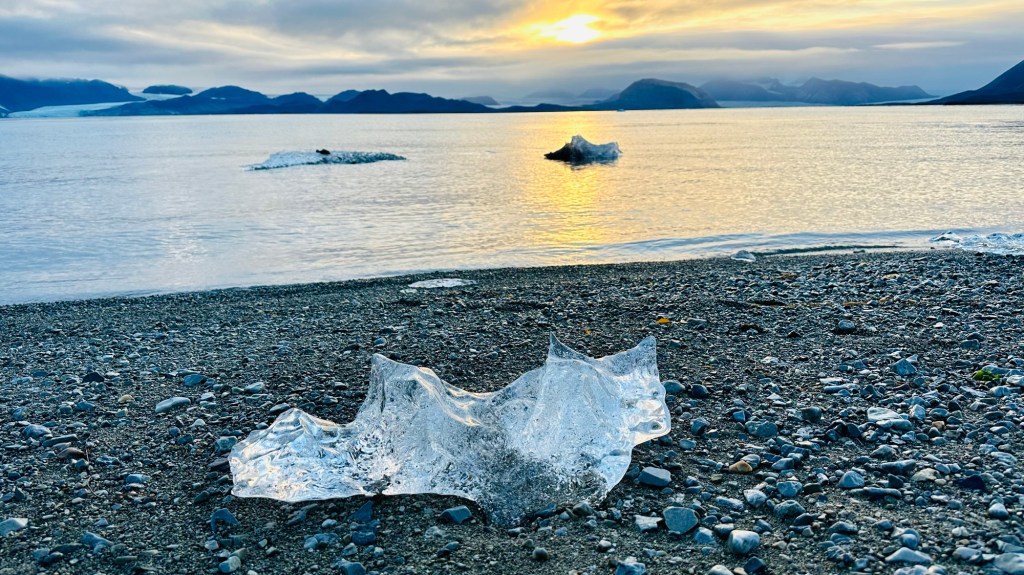
Ice on the shore of Kongsfjorden at Ny-Ålesund
Our ship had left Longyearbyen at 7pm on the evening of 14th. After we had dined in the restaurant, Claes told us that the ship’s captain had warned that we would be having a rocky journey up the coast from Longyearbyen to Ny-Ålesund. We went to bed at about 10pm, and experienced a 3-4 metre swell for approximately four hours. I felt like I was going to roll out of bed, so I didn’t get much sleep.
Unfortunately, we had no chance of a lie-in because the ship docked in Ny-Ålesund at 7am, as expected. As we were leaving again at 11am, we had to make the most of the time we had.
Ny-Ålesund is 79 degrees North and is the world’s northernmost permanent settlement. It is a research centre for scientists and is also used for environmental monitoring. Because of the sensitivity of the research equipment, we had to put all devices in flight mode before we reached the dock. We had already been warned that we could only walk on designated paths, and not to go beyond the boundaries that are marked out. We were also not allowed to feed any birds or animals, nor access the bird sanctuaries or the scientific areas.
As the ship docked, it really did feel like I was at the end of the world. From the comfort of our room, we could see glacial ice sheets on the mountains, lumps of ice in the sea and a very barren natural landscape. It looked very cold. We also saw a local guide stood with a weapon, watching the ship being tethered to the dockside. This is what we had been told about when we had had our briefing two days’ before. It was for the safety of the passengers and crew, just in case a polar bear might be in the vicinity.
Despite being a little unnerved about the prospect of polar bears possibly being around, it didn’t stop us from leaving the ship. We could see that the walk wouldn’t take long, as the settlement is tiny. The Coastal Experience Team were also walking about with binoculars so it made us feel more at ease.
When we had disembarked, we walked onto a small pier and then saw a beach on the left. There was no sand, only shingle, and a few large pieces of ice that had washed up on the shore. We could see the beautiful scenery across the Kongsfjorden and even a couple of seals popped up to say hello. In the distance we could see more ice sheets cascading down the mountainside, it was truly a wonderful sight.
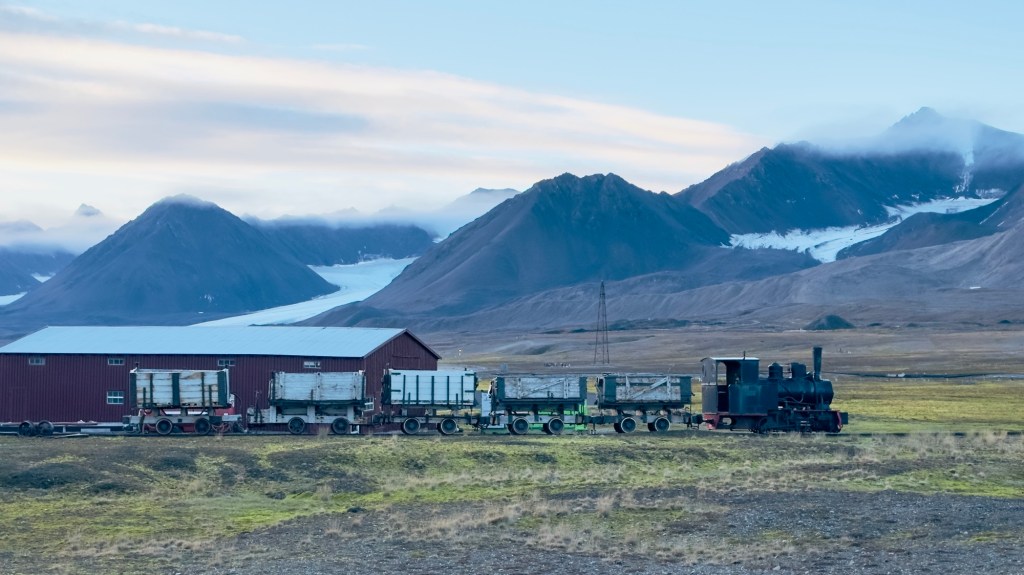
Moving on from the beach, we came across a disused train, which was used when the settlement was a mining community. The train was built in Berlin in 1909 and used to take coal from the mine to the quayside for onward transportation.
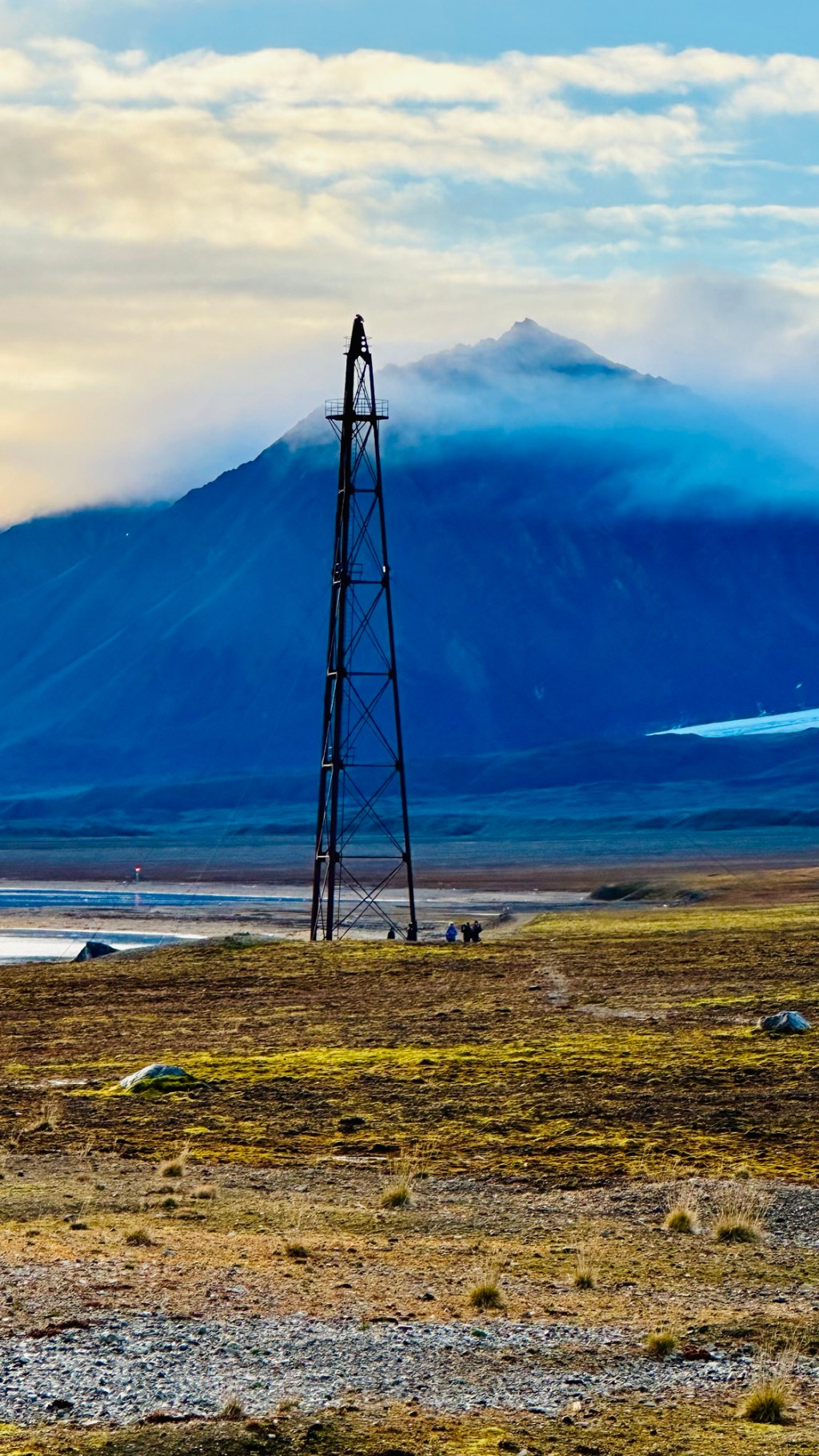
To the left of the train, further along the coast away from the ship, we saw Roald Amundsen’s airship mast, which was used boarding during Roald Amundsen’s North Pole expedition.
Going further down the designated path, we came across an impressive red building, named Tiedemann’s Tobak. I have read that this is a museum dedicated to the factory in Norway that was a major player in the food and beverage industry. The collection consists of objects, photographs and archives related to J. L. Tiedemann’s Tobaksfabrik (established in 1778). The Norwegian Folk Museum took over Tiedemann’s advertising and tobacco museum in 2010.
Further along is the Ny-Ålesund Museum. This was free entry so we decided to have a quick look. It isn’t a very big place but it told a lot about the different places there. For example, the Zeppelin Station, situated 474 metres above sea level on Zeppelinfjellet (Zeppelin Mountain), is used to measure climate and for environmental monitoring across the Arctic region. The focus of the research here comprises atmospheric science, marine studies, terrestrial research and the investigation of snow and ice. We saw pictures of how climate change has affected the landscape of the Arctic. There were photographs of the Blomstrandbreen glacier, taken in 1922 and 2002 and it was shocking to see how little ice is now left. The average temperature has increased by three times more than anywhere else in the world, which has caused glaciers, sea ice and snow to diminish. As we know, this does not only impact here, but the rest of the world too.
We didn’t spend long in the Museum and continued along the path. We came across the world’s northernmost post office. It is painted in a blue colour and is quite distinctive with a red post box on the outside. It was used as a general post office in the summer, and a schoolhouse in the winter. The building is not used as the post office now, but it has been retained as it was for historical reasons.
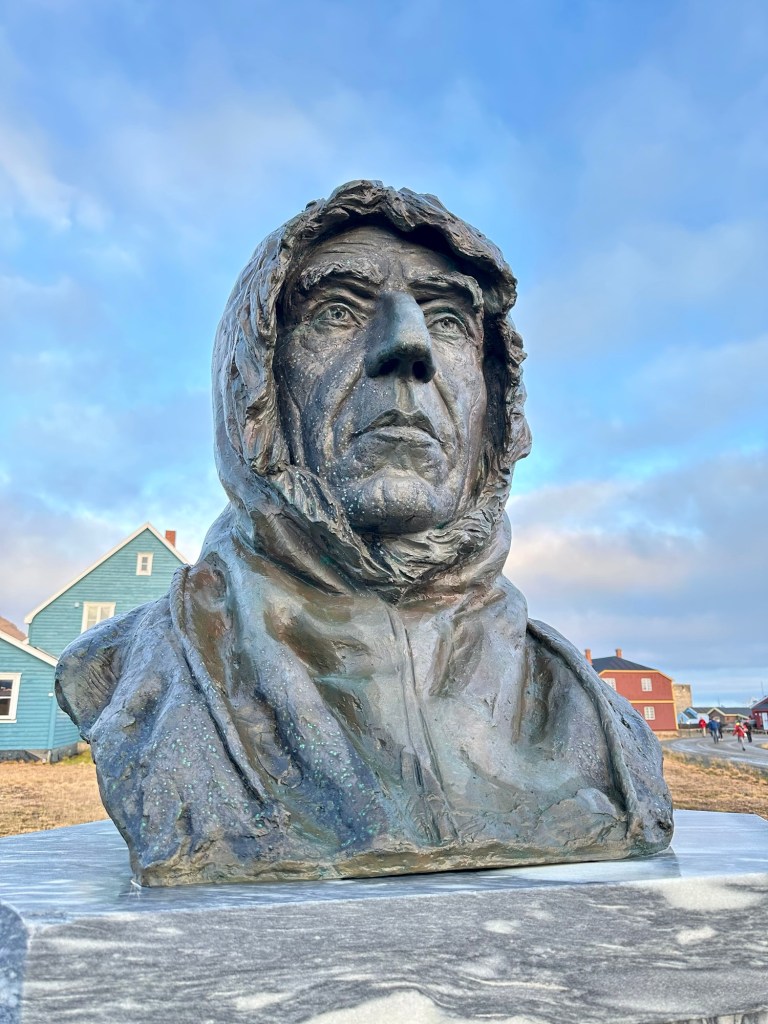
Further along, on the other side of the path is the Roald Amundsen statue, which is dedicated to the life and achievements of the great explorer. This statue is one of five bronzes that are placed in different areas of Norway.
The final building that we were interested in was the Telegraph Station. This is another facility that is no longer being used, but it was essential for Amunden’s polar expeditions, as well as being a link between Ny-Ålesund and the outside world. Amundsen contacted the Telegraph Station before he crashed his plane in 1928, and is believed to have happened in the Barents Sea after flying into thick fog.
At this point we headed back to the ship, taking more pictures as we walked along. The mist was starting the roll in across the mountains, which was good for practising my photography skills.
As we sat in our cabin we could see people milling about outside. Some of the crew and passengers had decided to go for an icy dip in the fjord, and there were some rather cold looking people heading back towards the ship after they’d got out of the water!
The ship left on time, 11am, as planned and we left a very misty and cold Ny-Ålesund behind us. We passed a couple of small icebergs, but they were nothing to be concerned about.
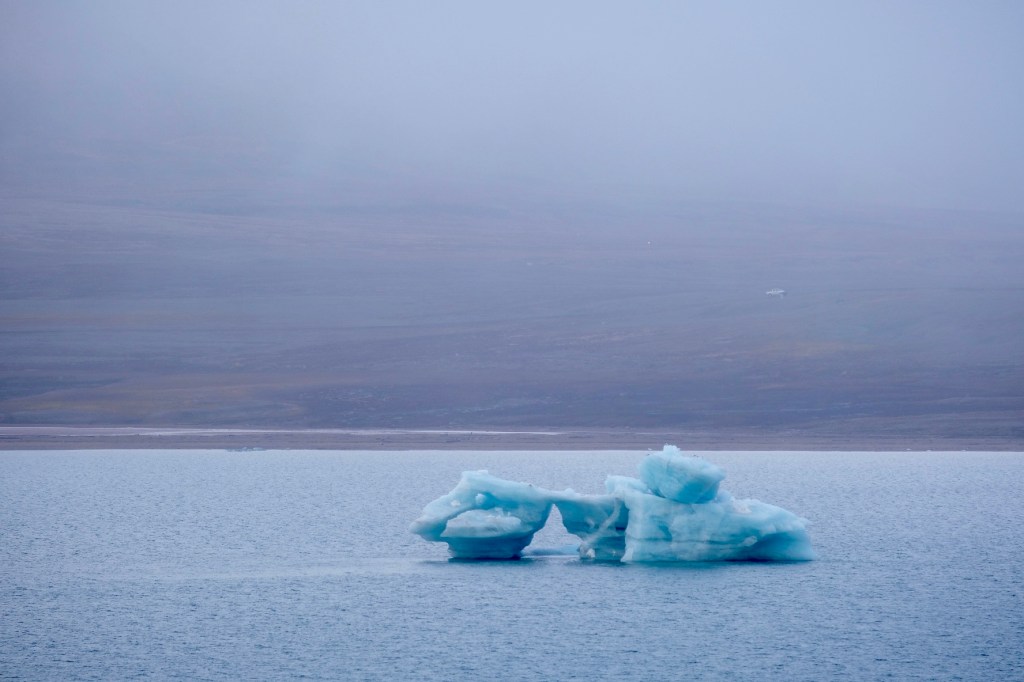
We just rested in the room before having lunch and then resting some more. We even got chance to watch a movie whilst chilling in the cabin.
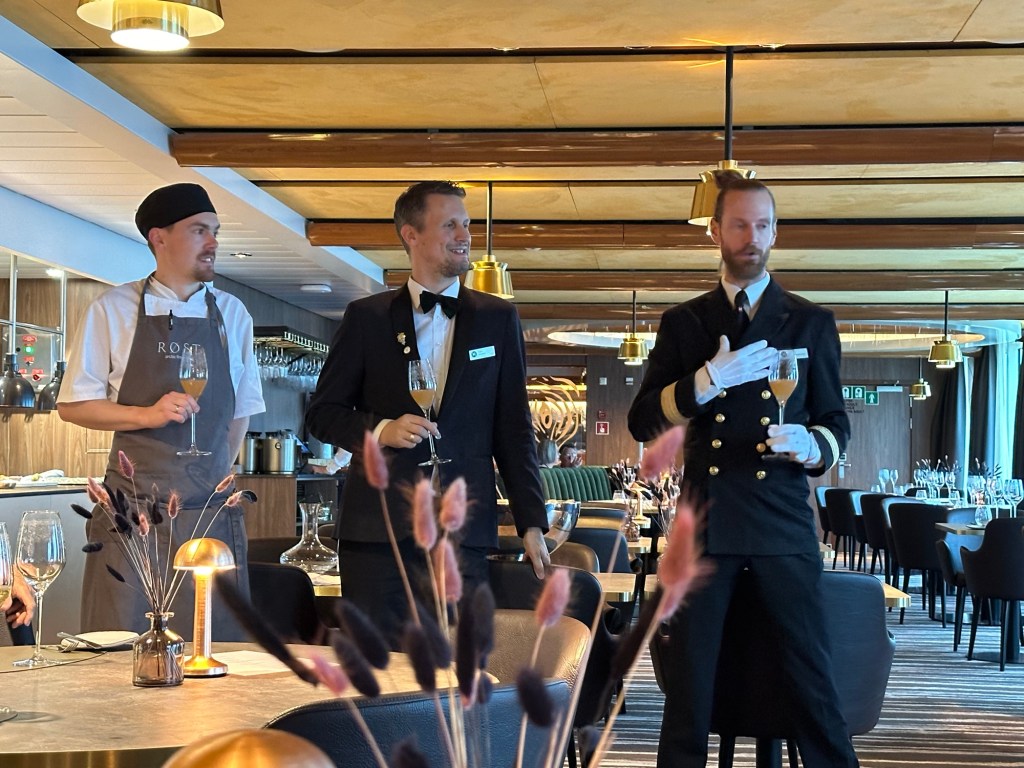
Our evening meal was booked at 6pm tonight. We had been invited by the restaurant manager to book a Chef’s dinner. This was only for twelve people and was sold as a seven course meal with pairing wines from the premium wines cabinet.
When we arrived we saw people that we usually saw when we had our evening meal. We were outdone by the Americans. There were three tables of 2, 3 and 4 Americans, a French couple and us. Yes, that makes 13 but the restaurant manager did it to suit the booking.
We had some of the most interesting food ever – I have sworn never to eat caviar after a bad incident in 1989, plus oyster which again I only ate once and spewed it back up again. However, the chef totally excelled himself this evening. He cooked every course and gave a presentation about each one as it was served. It was so interesting and different.
We got talking to a French couple who were sitting on the next table to us. The husband spoke very good English (he was looked after by a nanny in County Donegal). They are both in their 80s and were in the hotel industry. He owns five hotels in Paris and one in the South of France. He was very knowledgeable about everything and even knew the owner of one of the vineyards that had produced one of the wine pairings. He asked JC if he had ever been fishing, and of course he has. The French gentleman said that he went fishing as a young boy with Lord Mountbatten, who was a friend of his grandfather. They were dry fly-fishing and he told Lord Mountbatten that there was no fish. So Lord Mountbatten took some bait out of his pocket and threw it into the water and suddenly lots of fish appeared. I just thought it was a lovely memory that he shared with us.
The whole evening took four hours and restaurant manager Claes was very appreciative of our comments. The finale to the evening was giving everyone from the kitchen, and the restaurant staff, a round of applause before Claes took us to the 1893 bar for a final drink.
 jctraveller
Leave a comment