Please see link below for pictures…
Today we had no plan except for a long overdue walk across the Carrick-a-Rede rope bridge. More of that later.
Breakfast in the hotel was lovely and a nice relaxed affair. The staff were cheerful and attentive, and nothing was too much bother.
We set out on the road at about 930am and headed East from Bushmills along the Causeway Coastal Route. Our first stop was at Ballintoy Harbour, a place that provided the setting for some of the scenes from Game of Thrones. The car park was free to park. The beach was just so peaceful and tranquil; there was hardly anyone there apart from a couple in wetsuits with a dog. There are lots of natural formations of white limestone and black basalt, which is the same as what makes the Giants’ Causeway. We walked along the harbour wall which allowed us to see great views of Rathlin Island and Sheep Island. There are colonies of birds including cormorants, which form the largest colony in Northern Ireland.
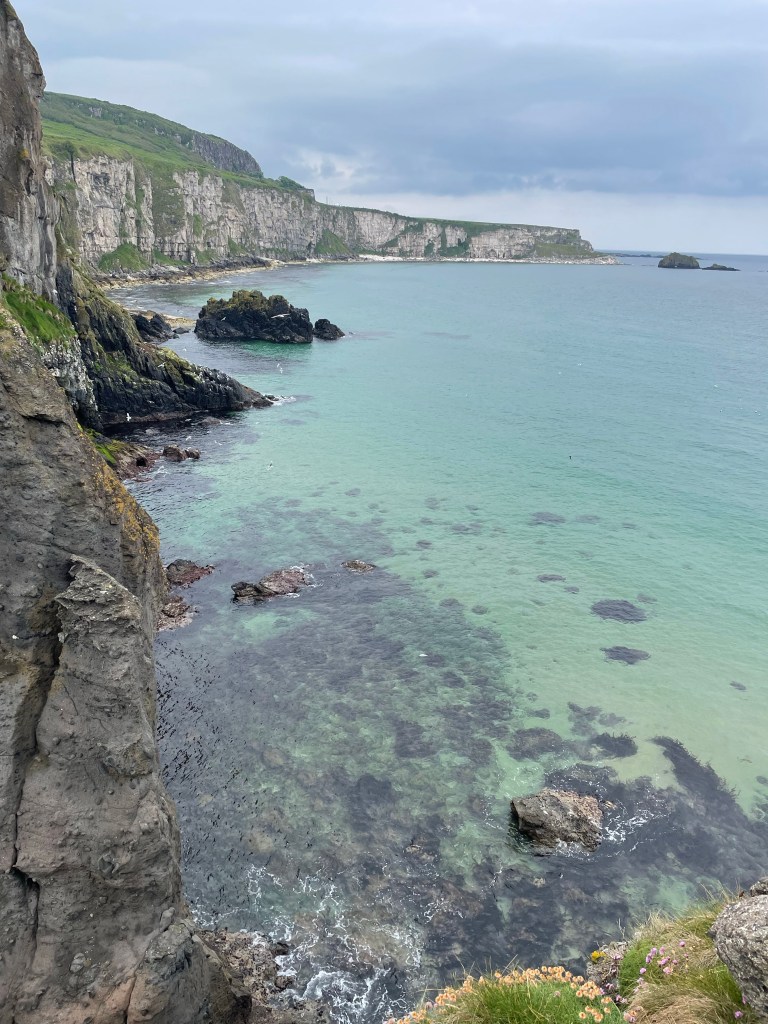
We jumped back in the car, and it was only a few minutes before we arrived at Carrick-a-Rede car park. This was somewhere that we wanted to go during our last visit in 2021, but it was closed due to Covid 19, and needed essential maintenance. It only reopened on 16th May 2022, so luck was on our side this time. It is advised to book ahead, otherwise your car parking and ticket to the rope bridge are not guaranteed https://www.nationaltrust.org.uk/carrick-a-rede. If you buy a ticket online, the car parking fee is paid for. Our pre-booked tickets cost £26 for two people. The walk to the bridge from the car park is roughly 0.6 miles, or 1km. The website warns that people must be able to walk there as there are stone steps, a bit of a steep walk and also metal steps to the bridge. Once we arrived at the bridge entrance we could see the beautiful coastline and the rope bridge, which is the only access to Carrick-a-Rede island. The bridge is 30 metres above sea level, and 20 metres in length and was erected by salmon fishermen over 250 years ago The island itself has a fisherman’s cottage, which is currently closed. Once you are on the island you can enjoy some amazing views of the rugged coastline, and also seabirds that are nesting on the cliff side. Not a lot of the island is roped off at the highest point so you just exercise caution and be careful near the edge. We took some amazing shots on the island. People were friendly and we took some photos for others as they did us.
Back across the bridge we set off again not knowing where we would end up. It wasn’t long before we saw a sign for Kinbare Head. A quick look up on Google and I read that there was a castle, so we headed there. It sounded as if it was a little off the beaten track from what I read. Car parking was free and we set off from the top of the cliff down some concrete stairs that have been built into the steep basalt cliff face. This is another place that I would say you need to be good on your pins! It is thought that the castle was built around 1547 by Colla MacDonnell, who belonged to the MacDonald clan who were lords of the Western Isles of Scotland, namely Jura, Kintyre and Islay.
We spent a short while on Kinbare Head where the castle is accessible up some more stairs. It’s a place of geological interest in that you can see white chalk from the Cretaceous period (80 million years old) and the black basalt of the Palaeogene period of 60 million years ago. The place was very quiet with just a few couples with dogs. It’s somewhere to go if you feel that you want to get away from it all. The car park has a mobile van where you can purchase tea, coffee and cakes. This is something well-deserved after climbing back up the steep steps!
Next we drove through Loughameena (The Vanishing Lake). In the spring a lake forms, usually around 6-8 feet deep. The ground where the lake forms is on a leaky chalk-bed with a “plug hole” that often becomes jammed with peat. This is when the lake forms, and empties again when the plug disappears. We must have been there when the lake had emptied as there was no water to be seen.
Back in the car, we followed the road south east. We drive for probably half and hour or so before we decided to stop at Cushendall for a bite to eat. Not many places were open as it was the public holiday for the Queen’s Jubilee but we managed to find Harry’s Bar. https://harryscushendall.co.uk/?utm_source=GMBlisting&utm_medium=organic . This looked as if it had been a bar at some point and had been modernised. It was light and airy, and the staff friendly and welcoming. We both chose freshly battered scampi which was served with home made chunky chips, mushy peas, tartare sauce and a small salad with balsamic dressing. It was a very generous portion for something from the lunchtime menu so we left feeling more than happy.
So after filling our bellies we headed further south to Glenarm, but not much was going on there. There is a castle where I believe you could take a nice walk. It was very quiet so we soon left after a brief walk round the harbour.
By this point we had decided to go back to Bushmills and arrived back at the hotel with time to sit outside the bar in the beautiful sunshine. The local gins, Jawbox and Shortcross, are two worthy of a mention.
We had booked the hotel restaurant again and this time opted for seafood options. I went for pan seared cod which was beautifully cooked.
We spent a couple of hours there before heading back to the room. It was an early night for an early start to return back to Belfast on Saturday, for the ferry to Liverpool.
 jctraveller
Leave a comment