Please click on the link to see a slideshow of my photographs. https://youtu.be/YMaLs-5iLcc
The religious celebrations started early on Friday and I could see, from the hotel window, large crowds gathering around the cathedral. Drums were banging as part of the ceremony as one of the pasos left the cathedral followed by the brotherhood.
We had nothing planned today. After breakfast we headed away from the hustle and bustle and found ourselves in the Jardines de Murillo. This beautiful park is named after the Spanish painter, Murillo, who was born in Seville. At one end of the park is the historic Balcón de Rosina. According to legend, this corner balcony inspired The Barber of Seville. Continuing through the park along the paseo de los litos (Mourning Walk) we saw a monument dedicated to explorer Christopher Columbus and also one to Catalina de Ribera. She founded the Hospital of the Five Wounds to care for poor women and was also a businesswoman.
We carried on down to the end of the park where there were a few stalls selling hats. Across the road, was another park, the Jardines del Prado de San Sebastián. We walked briefly through a leafy path and then headed down the Calle San Fernando. We passed the Real Fábrica de Tabaco de Sevilla, the city’s old tobacco factory. We then headed on to the Hotel Alfonso XIII. This amazing building was built around 1916-28 and was designed by architect José Espiau y Muñoz. We arrived at the Hotel Alfonso XIII just as it was opening time for the terrace restaurant, so we took the opportunity to ask if there was space for us. The front of house staff were very obliging and took us to a table straightaway.
There was no pressure here to order, it was a time to feel totally welcome and enjoy the outside terrace and gardens. We ordered a light lunch with some lovely vino blanco which was delicious. Here is a link to the menu for the terrace restaurant, Ena. http://cartasalfonso.qrmenuonline.es/CARTASHOTEL/CARTTAFULL.pdf
We also had a crème brûlée and a signature cocktail. A visit to los aseos was an excuse to take in the beautiful decor of the building. This included a small museum which had the throne of King Alfonso XIII on display. This used to be situated on the very spot where we ate lunch.
After leaving we headed back towards the hotel. It was busy but nothing like the day before.
After a couple of drinks on the hotel terraza, and a short siesta, it was time to head out again. We had already rebooked the restaurant that we didn’t get to last night, so I didn’t feel so bad about missing the booking. The restaurant was called Burro Canaglia Setas which was situated a few minutes away from Las Setas de Sevilla. The menu was similar to last night but the atmosphere was so much more relaxed.
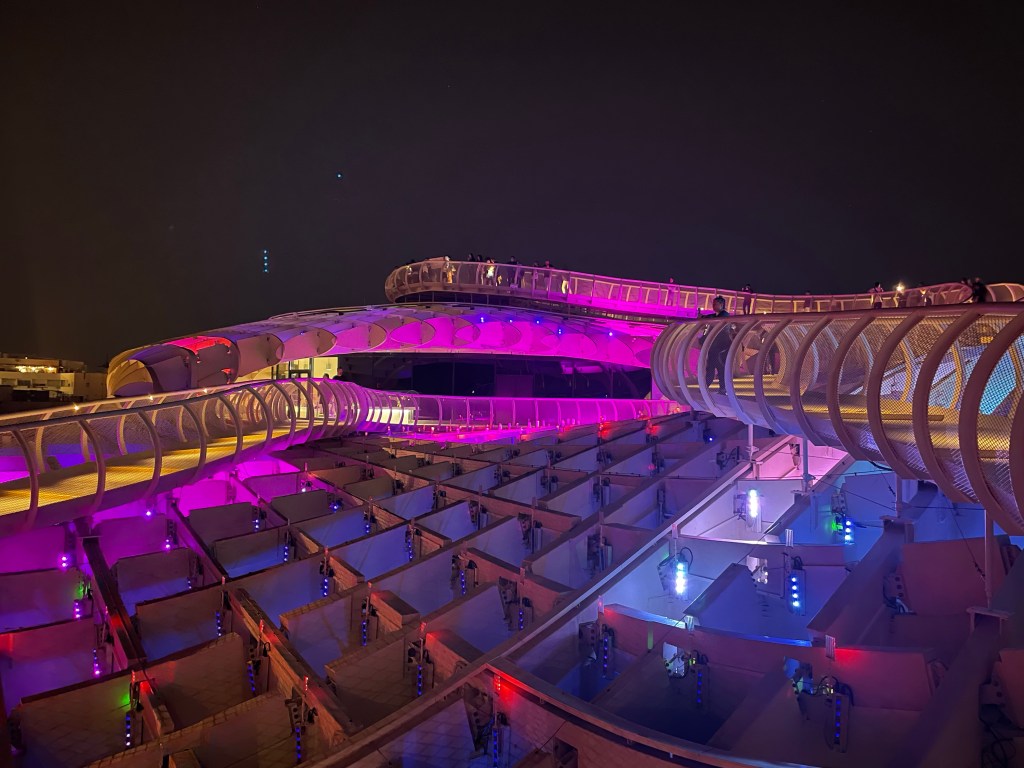
After another lovely meal, we headed to Las Setas de Sevilla which was literally two minutes round the corner. The online ticket was booked at 22:30, but it allowed us in at 22:00.
Las Setas means “mushrooms” in Spanish, and the structure is basically a giant mushroom shaped platform with 360 degree views. It was designed by a German architect called Jürgen Mayer and has been a tourist attraction since its completion in 2011 at a cost of 100 million euros. It is claimed to be the largest wooden structure in the world.
The structure consists of six parasols in the form of giant mushrooms, whose design is inspired by the vaults of the Catedral de Sevilla and ficus trees situated in the Plaza de Cristo de Burgos. Roman and Moorish remains, discovered on site before construction began, are displayed in a museum at the base of the Setas.
Getting to the top level viewing point is easy and gives amazing views of the city. During the hours of darkness Las Setas is lit up in a sequence of lights called Aurora. Details can be viewed here: https://setasdesevilla.com/en/home
A view of the Aurora in action: https://youtu.be/9ow_BprPHe8
It was a great experience and I thoroughly recommend visiting if you can.
 jctraveller
Leave a comment