26 months since I last flew on an aeroplane. 19 months since I last left the Common Travel Area to head to Amsterdam. Today was pretty special due to the fact that six previous trips abroad had been cancelled because of the Covid 19 pandemic. I couldn’t believe how quiet Heathrow was this morning. Was it because it was so early, or are many people still choosing not to travel? Probably a bit of both. The Airbus A320 was nearly empty, so the British Airways flight crew had a very easy job today, looking after the 20 or so passengers on board. The flight was meant to take 2 hours and 55 minutes but right from the start the pilot knew we’d arrive in Croatia early, 25 minutes early in fact.
I took in the views from the plane more than I’ve ever done before: the beautiful sunrise in the East and the cloud coverage over Western Europe that finally gave way to some amazing views of the Alps on the Swiss/Italian border. I lapped up the scenes in front of me, and was grateful for this opportunity.
Landing in Dubrovnik was a breeze, with a short bus ride to the terminal and an easy task of getting through customs. The Croatian entry form and Covid pass were prepared before departure to make it easier.
A taxi ride to Dubrovnik took about 20 minutes and along the way there were some beautiful views of the Adriatic coastline. The taxi driver said that we had come at the right time. In the summer there are many tourists from the cruise ships and it is also very hot!
As the hotel room wasn’t ready when we arrived, we had the chance to sit on the hotel sun terrace and take in the spectacular views of the sea and rugged coastline. It was 20+ degrees and we managed to get shade whilst enjoying a glass or two of Croatian white wine. We also had a light lunch which hit the spot.
Once the room was ready, it was time for a quick freshen up, and then we headed down to the old town. The Hotel Bellevue is about a 20 minute walk away from the main tourist area of Dubrovnik. It was a pleasant walk with some lovely scenery to take in.
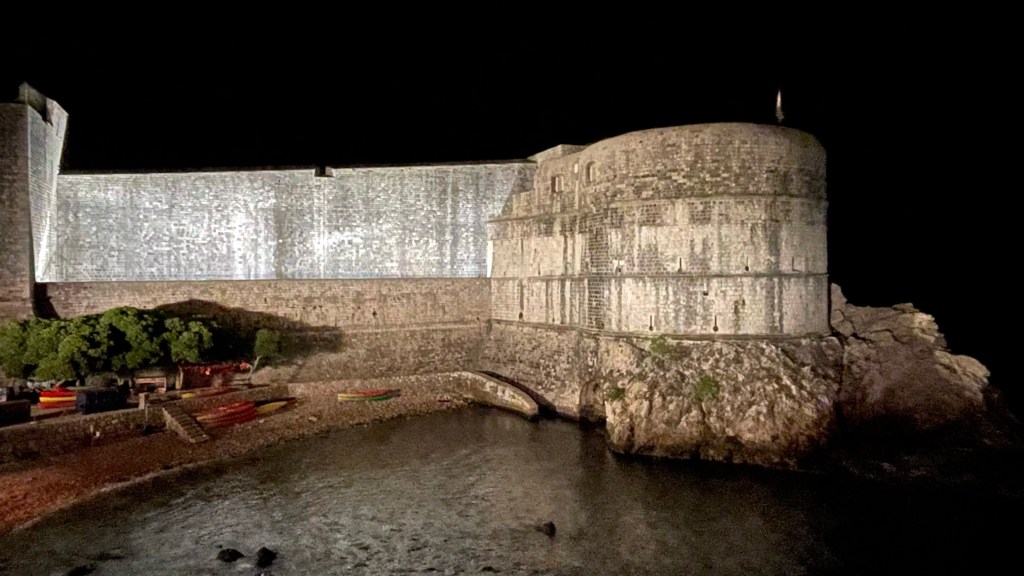
The first thing that we got to was the city walls of Dubrovnik and the dramatic entrance called Pile Gate (Vrata Pile). There is an old moat which is no longer full of water, but has become a garden. Walking down the ramp (instead of taking the stairs), you can see a map which shows the amount of devastation that the Serbs caused, along with the Montenegrins and the Yugoslav Army. This happened in 1991-1992, and there has been major repairs carried out to so many buildings and the city walls themselves. At the time of the attack the inhabitants did not have electricity or running water for many months. Also near the ramp is a small statue of St Blaise (Sveti Vlaho), the city’s patron saint. You need to look up or you’ll miss this sculpture, created by Croatian sculptor Ivan Meštrović.
The main thoroughfare through the old town is the marbled walkway of Stradun (Placa). You can see that there is some Venetian influence with the design of buildings, mainly due to them conquering the Slavic coast many centuries ago. There are many small streets off where we found cafes, bars and other gift shops. Walking to the end we came across Luža Square, which has a statue of a knight, and is named either Orlando’s Column or Roland’s Column. It was being renovated so we couldn’t see much of it. We did learn, though, that Orlando defended Dubrovnik against Saracen pirates in the 9th century. In the same square we saw the Clock Tower whose bell is hammered by little green men. Nearby is also the town hall (Gradska Vikećnjca) and the Marin Držič Theatre, as well as the Large Fountain of Onofrio. This has been a source of fresh water into the city since the 15th century.
Wandering through the pedestrianised area of this World Heritage site, we saw many beautiful buildings which had been renovated after the attacks in the 1990s. We came across some photos on the wall of a building that was destroyed by fire, and had since been restored. The owner, Ivo Grbić, a painter, has displayed some photos. One of the examples there shows him stood outside his house, which had been set on fire by three incendiary bombs that landed on it. There is a board nearby that explains how he had to rescue his 99 year old mother by carrying her to safety, after seven mortar shells landed on the house.
As the sun was starting to set we wandered about looking for somewhere to eat. We finally found Portun, down Od Sigurate, just off Stradun. This is a family owned restaurant and you could sense the pride that the staff had. The menu wasn’t too extensive but a lot of care and attention had been put into producing some lovely local seafood and meat dishes. Our waiter had a good command of English, with good knowledge of the menu and local wines. Once we had paid the bill, another waiter offered us both a drink “on the house” which we didn’t turn down. Grappa and nut liqueur both went down very well!
After a very early start, the only thing to do was head back to the hotel and catch up on some sleep.
 jctraveller
Leave a comment